

Knowledge
Trackout control and your SWPPP
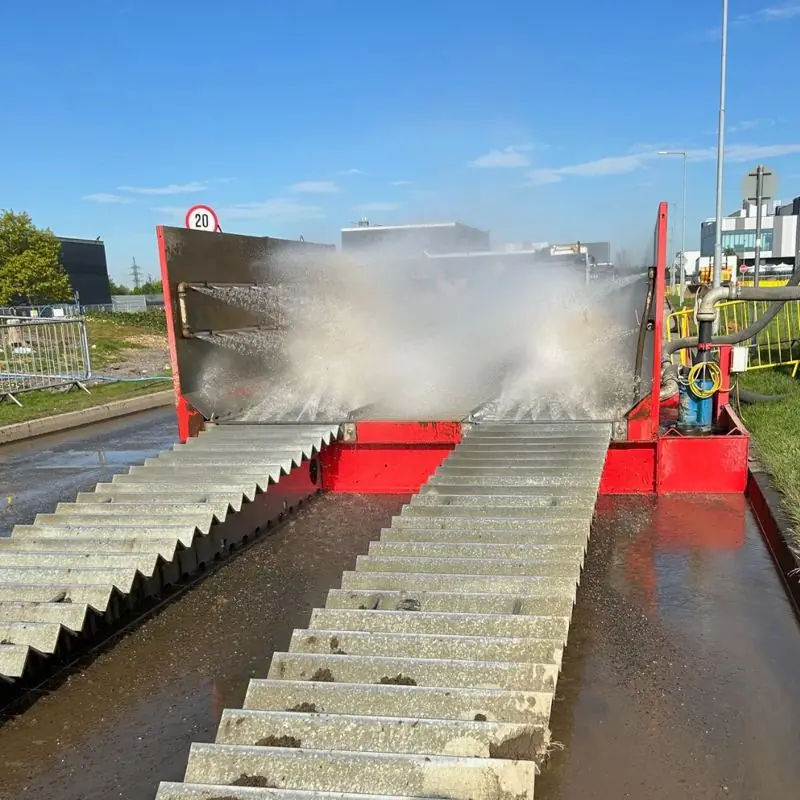
If your site disturbs an acre or more of ground in the United States, you almost certainly need stormwater permit coverage, and that permit makes you responsible for sediment your trucks carry onto paved roads.
What the federal permit requires
The EPA Construction General Permit covers construction sites where EPA is the permitting authority, and most state permits follow the same approach. Operators must minimize sediment track-out from vehicles leaving the site. In practice that means:
- restricting vehicles to designated exit points
- stabilizing those exits
- using additional controls where needed to remove sediment from tires before vehicles leave. The permit names wheel washing, rumble strips and rattle plates as examples
- removing any tracked-out sediment from paved surfaces by the end of the work day
Tracked-out sediment must not be hosed or swept into storm drains or drainage features.
Where a wheel wash fits
A stabilized stone exit works on light ground and in dry weather. On clay, in wet weather or with high traffic, it rarely keeps the road clean on its own, and daily road cleaning becomes a cost and a compliance risk. A wheel wash removes the sediment at the exit, before it reaches the road.
Wash water matters too. Permits restrict discharges from vehicle washing, so a closed-loop system that recycles its water and does not discharge to storm drains avoids creating a new problem.
Records and inspections
Your SWPPP sets out how track-out is controlled, and the site is inspected on a regular schedule. SiteWash Record, in beta, logs every wash with a timestamp and produces a weekly report, giving inspectors and clients a dated record of the control in operation. It supports your records; it does not replace your own permit obligations.
State and local rules
States with their own permitting programs, such as California and Washington, set their own requirements. Washington's stormwater manual includes a specific wheel wash best management practice, BMP C106. Always check the permit that applies to your site.
Frequently asked questions
Does the permit require a wheel wash?
Not by name. It requires operators to minimize sediment track-out and lists wheel washing as an example of an additional control where one is needed.
When must tracked-out sediment be cleaned up?
By the end of the work day in which it occurs, or by the end of the next work day if it occurs on a non-work day.
Can wash water go to a storm drain?
No. Tracked-out sediment must not be hosed or swept into storm drains, and permits restrict discharges from vehicle washing. A closed-loop wheel wash that does not discharge to storm drains avoids that.
The current federal Construction General Permit was issued in 2022 and expires on February 16, 2027. EPA has proposed a 2027 replacement. This guide is general information, not legal advice.